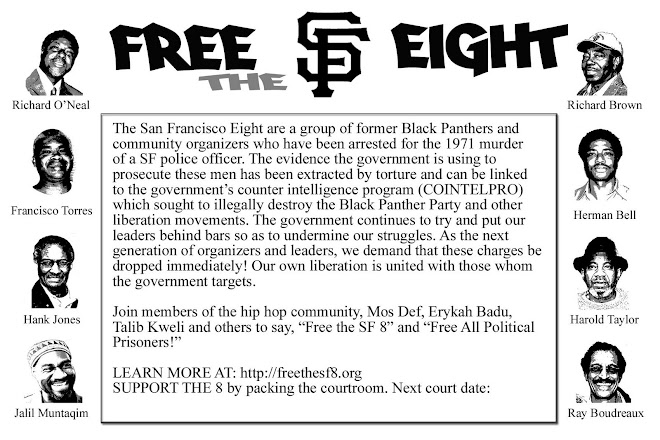
Judge Moscone denied defense motions to dismiss the conspiracy count against the remaining three San Francisco 8 defendants, Herman Bell, Jalil Muntaqim and Francisco Torres. While denying that issues about tolling and the statute of limitations are applicable in this case, he did say that the issue is not completely closed. The purpose of tolling statutes is to discourage defendants from fleeing a state to avoid prosecution by taking advantage of a statute of limitations. None of the three left the state to avoid prosecution. The statute of limitations on conspiracy is 3 years in California and was the basis of dismissing the conspiracy count against the other 5 defendants on February 7. Seven of the men remain charged with a 37 year old murder of a San Francisco police officer – Richard O’Neal was originally only charged with conspiracy and is no longer a defendant in this case. Moscone said that the motion to dismiss can be renewed at the conclusion of the preliminary hearing – scheduled to begin Monday, April 21.
According to Chuck Bourdon, Francisco Torres’ attorney, “the judgment was erroneously made” and that it relied on a case which is inapplicable to the issues presented. “The decision also ignores constitutional issues…and will be appealed to the California State Appellate Court immediately.”
According to today’s SF Chronicle, Gareth Lacey, spokesman for Attorney General Brown who green-lighted this prosecution, said “We have credible and strong new evidence.” Stuart Hanlon, Herman Bell’s attorney, said there is no new evidence in the case and much of the evidence - including the gun purportedly used in the shooting - has vanished. He asked the court, “so if this is true, where is it?” as it hasn’t been turned over to the defense as required by discovery laws.
Judge Moscone did ask prosecutors to give the defense a complete witness list two weeks before the preliminary hearing as well as making it possible for the defense team to have contact with Ruben Scott, who was one of the men captured in New Orleans in 1973, was tortured, and who is believed to be the main cooperating witness for the prosecution.
Friday, February 29, 2008

Displaced Persons (DP's)
Designation for various categories of the approximately six million persons who, during and after the Second World War, found themselves away from their homeland in Germany, Austria, and Italy. Most of them were labor conscripts, war prisoners, concentration camp prisoners, refugees, and other victims of war. The term ‘displaced person’ was applied initially to citizens of German-occupied countries; after 1945–6, when most of them had returned to their homelands, it was applied only to those refugees who refused to return to their countries, particularly those that were Communist-dominated.
In the narrower sense the term ‘displaced person’ was used to refer to the forcibly deported, while anyone who fled the advancing Soviet troops for political or other reasons was called a refugee. In practice, however, the two terms were used interchangeably. The legal designation ‘stateless person’ was also sometimes applied to those who refused to return to their homelands. In 1946, after the repatriation of most displaced persons, about 1.2 million remained in Germany and Austria, including over 200,000 Ukrainians. They lived mostly in displaced persons camps in the three occupation zones of West Germany and Austria. About 80 camps were predominantly Ukrainian; other Ukrainian refugees lived in mixed camps, and 25–30 percent lived outside the camps.
My mother's cousin is writing a book called "My Grandfather's Mill". He will tell the story of our family's struggle from Ukrain to North America as displaced people.
In the narrower sense the term ‘displaced person’ was used to refer to the forcibly deported, while anyone who fled the advancing Soviet troops for political or other reasons was called a refugee. In practice, however, the two terms were used interchangeably. The legal designation ‘stateless person’ was also sometimes applied to those who refused to return to their homelands. In 1946, after the repatriation of most displaced persons, about 1.2 million remained in Germany and Austria, including over 200,000 Ukrainians. They lived mostly in displaced persons camps in the three occupation zones of West Germany and Austria. About 80 camps were predominantly Ukrainian; other Ukrainian refugees lived in mixed camps, and 25–30 percent lived outside the camps.
My mother's cousin is writing a book called "My Grandfather's Mill". He will tell the story of our family's struggle from Ukrain to North America as displaced people.
Thursday, February 28, 2008
E-WASTE exporting harm
Electronic Waste is Toxic Waste
Over 1,000 materials, including chlorinated solvents, brominated flame retardants,PVC, heavy metals, plastics and gases, are used to make electronic products and their components—semiconductor chips, circuit boards, and disk drives.
A CRT monitor can contains between four and eight pounds of lead alone. Big screen TVs contain even more than that. Flat panel TVs and monitors contain less lead, but use mercury. About 40% of the heavy metals, including lead, mercury and cadmium, in landfills come from electronic equipment discards.
The Problem with Exporting Electronic Waste
Many recyclers can make more money by sending e-waste to developing countries for disassembly and processing. Most of it is sent to developing countries, like China, India, Pakistan, where workers make only pennies an hour.
Due to horrific working conditions and weak labor standards in many of the developing countries where e-waste is sent, women and children are often directly exposed to lead and other hazardous materials when dismantling the electronic products to recover valuable parts for resell. Workers in Guiyu, China - an area where a lot of e-waste "recycling" occurs, disassemble the products and throw the unwanted (but very hazardous) leaded glass into former irrigation ditches, and dump pure acids and dissolved heavy metals directly into their rivers. Piles of wires are burned in open fires, creating dioxins and furans.
In 2001, the Basel Action Network lead several groups in an investigation of e-waste processing in China, India, and Pakistan. The investigation uncovered an entire area known as Guiyu in Guangdong Province, surrounding the Lianjiang River just 4 hours drive northeast of Hong Kong where about 100,000 poor migrant workers are employed breaking apart and processing obsolete computers imported primarily from North America. The workers were found to be using 19th century technologies to clean up the wastes from the 21st century.
In San Francisco, the best place to take E-Waste is Green Citizen.
http://www.greencitizen.com/
Over 1,000 materials, including chlorinated solvents, brominated flame retardants,PVC, heavy metals, plastics and gases, are used to make electronic products and their components—semiconductor chips, circuit boards, and disk drives.
A CRT monitor can contains between four and eight pounds of lead alone. Big screen TVs contain even more than that. Flat panel TVs and monitors contain less lead, but use mercury. About 40% of the heavy metals, including lead, mercury and cadmium, in landfills come from electronic equipment discards.
The Problem with Exporting Electronic Waste
Many recyclers can make more money by sending e-waste to developing countries for disassembly and processing. Most of it is sent to developing countries, like China, India, Pakistan, where workers make only pennies an hour.
Due to horrific working conditions and weak labor standards in many of the developing countries where e-waste is sent, women and children are often directly exposed to lead and other hazardous materials when dismantling the electronic products to recover valuable parts for resell. Workers in Guiyu, China - an area where a lot of e-waste "recycling" occurs, disassemble the products and throw the unwanted (but very hazardous) leaded glass into former irrigation ditches, and dump pure acids and dissolved heavy metals directly into their rivers. Piles of wires are burned in open fires, creating dioxins and furans.
In 2001, the Basel Action Network lead several groups in an investigation of e-waste processing in China, India, and Pakistan. The investigation uncovered an entire area known as Guiyu in Guangdong Province, surrounding the Lianjiang River just 4 hours drive northeast of Hong Kong where about 100,000 poor migrant workers are employed breaking apart and processing obsolete computers imported primarily from North America. The workers were found to be using 19th century technologies to clean up the wastes from the 21st century.
In San Francisco, the best place to take E-Waste is Green Citizen.
http://www.greencitizen.com/
Friday, February 22, 2008
Sheriff's Deputies Arrest Students at D-Q University
On Wednesday, February 20th, students at D-Q University which is California's only tribal college, reported that Yolo County deputies had begun arresting them for allegedly "trespassing" on campus. As many as four students were taken to the Yolo County Jail, and it is believed that more arrests may follow. Students are calling for support from the community, and are asking for people to come out and witness the deputies' actions. D-Q University is located at 33250 Road 31 in Davis.
In 1970, groups of Native Americans and Chicana/o students from several universities and colleges organized themselves to lay claim to a decommissioned military installation. Their goal was to create a learning environment through the unified cultures of the indigenous peoples of the Americas. Since students and members of the community started a revitalization process in 2005, dozens of students have remained on campus and have been able to organize workshops and classes based in Native Philosophy and Cultural Revitalization. They are committed to the pursuit of an indigenous education while working towards the future as they honor the past.
more info and news at http://www.indybay.org/
In 1970, groups of Native Americans and Chicana/o students from several universities and colleges organized themselves to lay claim to a decommissioned military installation. Their goal was to create a learning environment through the unified cultures of the indigenous peoples of the Americas. Since students and members of the community started a revitalization process in 2005, dozens of students have remained on campus and have been able to organize workshops and classes based in Native Philosophy and Cultural Revitalization. They are committed to the pursuit of an indigenous education while working towards the future as they honor the past.
more info and news at http://www.indybay.org/
Thursday, February 21, 2008
Benefit for the New Jersey 4 Tonight!
http://www.indybay.org/newsitems/2008/02/01/18476283.php
New Jersey 4: young black lesbians convicted for defending themselves against a sexist and homophobic attack.
New Jersey 4: young black lesbians convicted for defending themselves against a sexist and homophobic attack.
Wednesday, February 20, 2008
Support Local Tree Sit
With the fall of the Bear Mountain tree-sit in Victoria, BC, it seems like this is a very crucial time for activists in the trees up and down the west coast. There are two campus trees-sits, one under attack right now at UC Berkeley and one at UC Santa Cruz. These actions are opposing the unnecessary development of greenspace.
The Berkeley Action is opposed to the destruction of a large grove of Coast Live Oaks in order for the campus to place an athletic training center adjacent to the campus stadium. As if the "atheletes" need a training center so close to the stadium. Maybe they are afraid of a little walk for some exercise? To make things even more contraversial, the grove is memorial dedicated to fallen Californian World War I soldiers. To top that off, 18 Native Americans were discovered buried under the stadium in 1923. This area is sacred and needs protection from furthur development. The city of Berkeley opposes the development. However, the UC only has to abide by state laws, concerns and constraints. In other words, the UC campus is comparable to a Federal agency, which answers to pretty much no one, especially local concerns of the city's residents. I suggest that if you are reading this and you are in the Bay area, that you head up to the stadium to help them. They need your help now more than ever!
The Berkeley Action is opposed to the destruction of a large grove of Coast Live Oaks in order for the campus to place an athletic training center adjacent to the campus stadium. As if the "atheletes" need a training center so close to the stadium. Maybe they are afraid of a little walk for some exercise? To make things even more contraversial, the grove is memorial dedicated to fallen Californian World War I soldiers. To top that off, 18 Native Americans were discovered buried under the stadium in 1923. This area is sacred and needs protection from furthur development. The city of Berkeley opposes the development. However, the UC only has to abide by state laws, concerns and constraints. In other words, the UC campus is comparable to a Federal agency, which answers to pretty much no one, especially local concerns of the city's residents. I suggest that if you are reading this and you are in the Bay area, that you head up to the stadium to help them. They need your help now more than ever!
Over 130 Wild Buffalo Slaughtered with 145 More Facing Imminent Death
Advocates Hold Week of Action as Yellowstone Bison Slaughter Continues
GARDINER & WEST YELLOWSTONE, MT: Over 130 wild buffalo have been slaughtered by the National Park Service in Yellowstone since February 8th. They have captured a total of 275 and plan to slaughter all of them. According to Yellowstone officials, 17 calves that were originally going to be sent to the Corwin Springs research facility are now instead being sent to slaughter.
"Originally the U.S. Calvary was sent here to protect the last remaining bison found in Yellowstone," said Mike Mease, co-founder of Buffalo Field Campaign. "How sadly ironic that millions of U.S. tax dollars are now being spent to kill them."
George Cadman of Free Radio Santa Cruz 101.1 FM spoke with Stephany Seay of the Buffalo Field Campaign about the real reasons behind the slaughter, what they are doing to fight this and how people can get involved. Read More and Listen to the Interview
GARDINER & WEST YELLOWSTONE, MT: Over 130 wild buffalo have been slaughtered by the National Park Service in Yellowstone since February 8th. They have captured a total of 275 and plan to slaughter all of them. According to Yellowstone officials, 17 calves that were originally going to be sent to the Corwin Springs research facility are now instead being sent to slaughter.
"Originally the U.S. Calvary was sent here to protect the last remaining bison found in Yellowstone," said Mike Mease, co-founder of Buffalo Field Campaign. "How sadly ironic that millions of U.S. tax dollars are now being spent to kill them."
George Cadman of Free Radio Santa Cruz 101.1 FM spoke with Stephany Seay of the Buffalo Field Campaign about the real reasons behind the slaughter, what they are doing to fight this and how people can get involved. Read More and Listen to the Interview
Largest Beef Recall Ever After Video Exposes Downed Cow Abuse
Tue Feb 19 2008
Downed Cow Beef Had Been Supplied to Needy, Elderly, and Children Nationwide
The Humane Society of United States (HSUS) conducted a video-taped undercover investigation of Hallmark Meat Packing Company slaughterhouse in Chino, California. The six-week investigation was conducted in secret by an investigator who posed as an employee. The investigator documented cows unable to walk, known as "downed" cows, being rammed with the blades of a forklift, jabbed in the eyes, stabbed with electric prods and sprayed in the nose with high-pressure water hoses. Under federal regulations, only animals able to walk on their own can be used for meat. Downed cattle, which have higher occurrences of mad cow disease and other health issues, are supposed to be euthanized and removed immediately.
The video was released to the public by HSUS on January 30th. The video led to San Bernardino County district attorney filing criminal charges against two workers on February 15th, and then on February 17th, the USDA announced the recall of 143 million pounds of beef that came from the Chino plant, making it by far the largest beef recall in U.S. history. The plant has since been closed. USDA officials have noted, though, that most of the beef intended for the recall has already been consumed. The Chino slaughter plant had supplied the Westland Meat Company, which processes the carcasses. The facility is the second-largest supplier of beef to USDA's Commodity Procurement Branch, which distributes the beef to needy families, the elderly and also to schools in 36 states through the National School Lunch Program.
Downed Cow Beef Had Been Supplied to Needy, Elderly, and Children Nationwide
The Humane Society of United States (HSUS) conducted a video-taped undercover investigation of Hallmark Meat Packing Company slaughterhouse in Chino, California. The six-week investigation was conducted in secret by an investigator who posed as an employee. The investigator documented cows unable to walk, known as "downed" cows, being rammed with the blades of a forklift, jabbed in the eyes, stabbed with electric prods and sprayed in the nose with high-pressure water hoses. Under federal regulations, only animals able to walk on their own can be used for meat. Downed cattle, which have higher occurrences of mad cow disease and other health issues, are supposed to be euthanized and removed immediately.
The video was released to the public by HSUS on January 30th. The video led to San Bernardino County district attorney filing criminal charges against two workers on February 15th, and then on February 17th, the USDA announced the recall of 143 million pounds of beef that came from the Chino plant, making it by far the largest beef recall in U.S. history. The plant has since been closed. USDA officials have noted, though, that most of the beef intended for the recall has already been consumed. The Chino slaughter plant had supplied the Westland Meat Company, which processes the carcasses. The facility is the second-largest supplier of beef to USDA's Commodity Procurement Branch, which distributes the beef to needy families, the elderly and also to schools in 36 states through the National School Lunch Program.
Monday, February 18, 2008
SF8 Court Update
February 13: Missing evidence questioned
The hearing on Wednesday, February 13 focused on questions by the defense of a San Francisco City Prosecutor and a retired District Attorney investigator about evidence missing from the investigator's files on the 1975 police killing. The only files turned over to the defense from the original investigation contain no police reports, no ballistics evidence, no witness interviews, and no lab files. The DA’s file did contain some notes – particularly important since the notes and correspondence referenced other materials in the possession of the prosecution. Most notably missing were reports of the fingerprint comparisons – with negative results, no matches to any of the defendants. Also absent is the memorandum prepared by then prosecutor Thomas Norman stating the reasons for not going forward with the prosecution in 1975.
The hearing on Wednesday, February 13 focused on questions by the defense of a San Francisco City Prosecutor and a retired District Attorney investigator about evidence missing from the investigator's files on the 1975 police killing. The only files turned over to the defense from the original investigation contain no police reports, no ballistics evidence, no witness interviews, and no lab files. The DA’s file did contain some notes – particularly important since the notes and correspondence referenced other materials in the possession of the prosecution. Most notably missing were reports of the fingerprint comparisons – with negative results, no matches to any of the defendants. Also absent is the memorandum prepared by then prosecutor Thomas Norman stating the reasons for not going forward with the prosecution in 1975.
Friday, February 1, 2008
Support the SF8
Come to court:
Thurs, Feb. 7
9:30 a.m. hearing
850 Bryant St, SF
Department 23, 3rd floor
On Thursday, February 7th arguments will be made to drop the remaining conspiracy charges against Herman Bell, Jalil Muntaqim (Anthony Bottom) and Francisco Torres. The prosecution claims that because the three men were not in California the statute of limitations does not apply. This “ridiculous technicality” will be vigorously challenged by defense attorneys as Herman and Jalil have been political prisoners for 34 and 36 years and Francisco was residing in New York. All three have been consistently available to California state prosecutors.
Thurs, Feb. 7
9:30 a.m. hearing
850 Bryant St, SF
Department 23, 3rd floor
On Thursday, February 7th arguments will be made to drop the remaining conspiracy charges against Herman Bell, Jalil Muntaqim (Anthony Bottom) and Francisco Torres. The prosecution claims that because the three men were not in California the statute of limitations does not apply. This “ridiculous technicality” will be vigorously challenged by defense attorneys as Herman and Jalil have been political prisoners for 34 and 36 years and Francisco was residing in New York. All three have been consistently available to California state prosecutors.
Subscribe to:
Comments (Atom)